

Streamlining referral management
Company
Elemy
Role
Product Design Concept Test
Team
1 PD (me), 1 PM, 1 SE, 1 UXR, 1 UX Writer
Duration
2 weeks
01 Overview
Concept testing with pediatricians, office managers, and referral coordinators shifted the MVP toward workflows that fit real clinic operations. We removed QR self-enrollment and medical document upload to reduce friction and engineering lift, while still enabling fast referrals. We prioritized a lightweight status dashboard with phase visibility, filtering, and sorting to help clinics track progress and close referral loops. The patient details drawer was descoped, and tooltips clarified referral phases without adding UI complexity.
02 Context
Pediatricians are a high-trust referral source, but Elemy lacked a scalable referral system and post-referral visibility. This led to low referral volume, poor patient tracking, and weak follow-up. Testing showed providers had limited time, so the MVP focused on a simple referral form and a clear status dashboard—helping clinics close loops and increasing adoption without adding BD overhead.
03 The Problem
Low referral volume
Existing referral process lacked an easy clearly defined workflow, limiting adoption
Difficult to track patient progress
Pediatricians had limited visibility into whether referred families started care and how they were progressing
Low visibility of inactive patients
clinics couldn’t easily identify referrals that stalled or dropped off, making follow-up difficult
04 Explorations
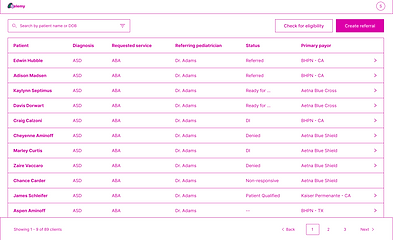
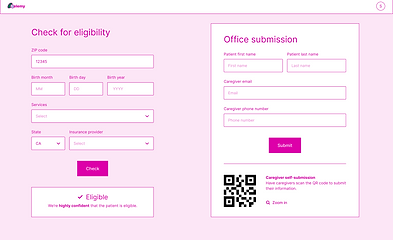
The initial designs focused on creating a fast, low-effort referral experience while building trust through visibility and follow-up support. I prioritized two core workflows—creating a referral and viewing an existing referral—and iterated through multiple low-fidelity concepts before prototyping for concept testing with pediatricians and clinic staff. The goal was to deliver a scalable portal that increases referral volume without adding overhead for the BD team.

05 Research
Concept testing revealed that while in-room referrals via QR code sounded appealing, they didn’t match real workflows—referrals were typically completed at checkout or after visits. An insurance eligibility check was a must-have for staff. The status dashboard was highly valued: pediatricians wanted quick visibility and care updates, while office staff needed actionable follow-up tools (e.g., to-do lists/filters) to close loops.
“I can’t do this during the visit—it would slow me down. We only have 15 minutes.”
- pediatrician
“This would work great for us. It’s quick and wouldn’t slow us down.”
- office manager
06 Final Designs
The MVP aligned with clinic reality through a low-friction referral form and a lightweight dashboard for status tracking. Removing QR enrollment and document uploads simplified submission, while phase visibility, date filtering, and tooltips supported follow-up without increasing UI complexity.
Referral status dashboard
A dashboard that surfaces referral phases and statuses at a glance, with sorting and filtering to help clinics prioritize follow-ups and close referral loops.

Referral form
A streamlined, low-friction form that enables clinic staff to submit referrals quickly within real pediatric office workflows.

Insurance eligibility check
Built-in eligibility validation to confirm accepted insurance upfront, saving time for both office staff and families.


07 The Impact
Measured 3 months after launch
278/mo
Referrals submitted via portal
43%
Clinic activation rate
17%
Reduction in inactive referrals
08 Reflection
Exploring an ideal end-state experience helped create a clear long-term vision for what the referral product could become, even if not everything was feasible for MVP. As we cut scope, I learned how important it is to balance a strong user experience with engineering lift—prioritizing the few features that deliver the most value with the least complexity. Most importantly, speaking directly with pediatricians and clinic staff was critical: several early assumptions were invalidated, and the concept testing insights led to major pivots that made the MVP more realistic, usable, and likely to be adopted.
